How to Draw an Owl
- Draw some circles. 2. Spontaneously achieve perfect emotional fluidity.
TW: discussion of self-abuse. Also, mild spoilers for Mark Z. Danielewski’s House of Leaves and Joachim Trier’s Sentimental Value.
March 31st
I often feel sad, but unable to “move sadness”, to use the parlance of Joe Hudson. Why does the sadness feel so sticky, so immovable? Internet gurus prescribe “feeling your feelings” as the way to deal with the difficult and the uncomfortable, but what does this even mean?
My therapist frequently suggests that I ought to explore grief more. My intuition rails against this - I am already sad so often! Why would I invite grief into my life? Surely this is indistinguishable from sadness?
He has put it to me that grief has a kind of detoxifying framing for the sadness. Grief means it’s not my fault. Grief means it was an inevitable part of life. In sadness, there is ample room for self-abuse; less so in grief.
And really, I abuse myself a lot. Like, a lot. I might not show it, but it is there, in my mind, all the time. There are myriad forms of self-harm - some are visible to others, like cutting or alcohol dependency, some are subtler, like many eating disorders, and others are often entirely out of view of the world at large, like a voice in my head that tells me that I am uniquely deficient, bad, broken, undeserving, inadequate, all day, every day.
Most of the time, I don’t even notice it anymore; it simply blends into the background. It has a similar quality to tinnitus. I have learned to compensate for it, and I don’t acknowledge its presence to anyone because I’ve stopped consciously noticing it as much as because I am ashamed of it. I’ve come to accept the pain that it causes as part of my natural, everyday life.
And therein lies the reason that my sadness is sticky - it isn’t just regular sadness. It’s sadness that is underpinned by a monstrous, parasitic inner critic, one that has managed to subsume its host so thoroughly that I don’t even notice its presence. It tacitly attaches “and it’s all your fault” to any sad thing that happens. Even if it couldn’t conceivably be causally because of me, it can still be karmically because of me - “and you deserve it”. Often, the only thing it tells me I deserve is death.
My therapist also recently suggested that I ought to confront “the monster under the bed”. My mind went immediately to House of Leaves, imagining my conscious self as Will Navidson, my psyche as the house in Virginia that he and his wife purchase. The monster under my bed conjures the forbidden door in Navidson’s house. Common sense says not to open the door - nothing good will be found there. But Navidson knows he must go, regardless. Once he becomes aware of the existence of the labyrinth, he is compelled to explore it, for reasons he is unable to explain to his wife or children.
It would be easy to drift past the door - to pretend that it is locked, the whereabouts of any key unknown, much like I might prevent myself from turning my mind’s eye to my inner critic. Indeed, I have drifted past the door my entire adult life, and am reluctant to even admit to you that the door exists at all. Sadly, another Joe Hudsonism that I strongly suspect is true and real is that my avoidance betrays where I ought to seek out healing. To continue to drift past the door would be to continue to allow Athenian youths to be sacrificed as tribute to the minotaur, and that is simply something our noble hero cannot abide. So I must take up my clew and prepare for battle.
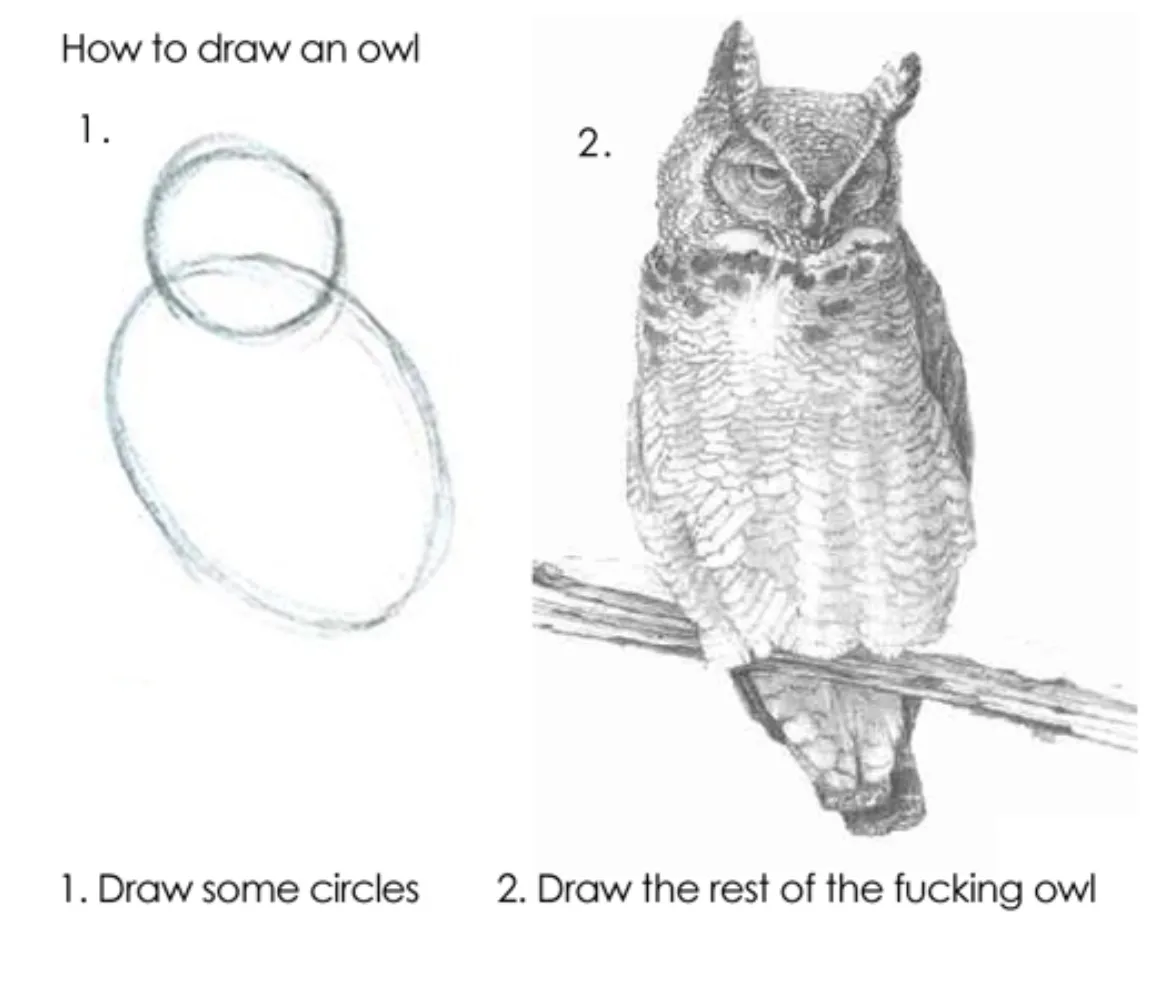
I particularly enjoyed this Joe Hudson video1 about responding to the inner critic, once noticing it has been accomplished. I like the options he presents: “ouch”, “fuck you”, “I see how scared you are”, “if we’re being results-oriented then you have a horrible managerial track record and so perhaps it’s time we let someone else have a go at being in charge”, etc. I’ve always found the instruction “simply feel your feelings” completely maddening; akin to saying “draw the rest of the fucking owl”. It’s like telling me to reach out and grab the mug in front of me with the third arm I have in the middle of my chest - as far as I am aware, I have no mind-muscle connection that allows me to do this thing. The pithiness of the instruction makes it seem smug, which in turn leaves me feeling impotent and infuriated (although perhaps this is by design, given anger certainly counts as a feeling).
My new, clunkier instruction is thus: “try to feel your feelings, expect the inner critic to loudly prevent you from doing so, experiment with responding to it with curiosity rather than ignoring it, see if this allows you to actually feel your feelings and ‘move them’”.
I feel optimistic about this, as there are occasions when I feel my feelings just fine, but only when my defences are circumvented. I cry horribly at films, with minimal prompting (i.e. I cried at the trailer for The Salt Path when it came on before a different showing in the cinema - not even the actual movie!), but rarely cry about anything in my own life, despite having a lot of difficult feelings I would prefer to release. In watching another Joe Hudson video, he breaks down a therapist scene from Good Will Hunting, and even though the scene lacks any context from the rest of the movie (which I haven’t seen, thus had no attachment to the characters beforehand), I cried watching it. I haven’t even cried in my own therapy sessions! Of which there have been many! During them we talk about the literal worst things that have ever happened or might ever happen to me!!!! What the fuck is up with that?
Relatedly, I’ve been putting off watching Sentimental Value, because I know I will cry a lot at it. I will not be able to compartmentalize, and I suspect it will leave me a sobbing wreck. I feel actively afraid of this, despite on some level being able to recognise that the film will likely offer some catharsis for me. Now I’m of the opinion that the fact I’m scared to watch it is a signal that that’s exactly what I ought to do. And I can see whether or not being able to feel my feelings, without being interrupted by my inner critic, is indeed cathartic. And if it is, then I can really work on how to go about working with my inner critic in order to be able to sit down and feel my feelings whenever the need arises.
May 13th
like a voice in my head that tells me that I am uniquely deficient, bad, broken, undeserving, inadequate, all day, every day.
I can’t hear this voice today, even if I listen for it. Perhaps it is still lurking, somewhere in my psyche, but I’m not really sure how helpful the concept of latent parts is when exploring my theory of mind. It seems like I was straightforwardly wrong to say “all day, every day”, but, in my past self’s defence, the days it’s there are much more memorable than those in which it’s absent, so it makes sense to me that I’d feel it was ever-present.
My new, clunkier instruction is thus: “try to feel your feelings, expect the inner critic to loudly prevent you from doing so, experiment with responding to it with curiosity rather than ignoring it, see if this allows you to actually feel your feelings and ‘move them’”.
I hate this! So vague, so abstract, so pretentious! This feels only marginally better than the “draw the rest of the fucking owl” instruction. Regrettably, the more “inner work” (also a gross and pretentious phrase) I do, the more I realise that all the obscure phrases are true and useful, and the work itself is to figure out why they’re true and useful; the value in them lies in the process of understanding them, more than any wisdom they themselves might impart.
Relatedly, I’ve been putting off watching Sentimental Value, because I know I will cry a lot at it. I will not be able to compartmentalise, and I suspect it will leave me a sobbing wreck. I feel actively afraid of this, despite on some level being able to recognise that the film will likely offer some catharsis for me. Now I’m of the opinion that the fact I’m scared to watch it is a signal that that’s exactly what I ought to do. And I can see whether or not being able to feel my feelings, without being interrupted by my inner critic, is indeed cathartic.
I managed to follow through on my intentions and recently watched the film. Not only that, I watched it with a friend, as an attempt to practice vulnerability, and in particular, crying in front of others. The experiment somewhat worked, although not quite in the way I expected it would. I didn’t end up a sobbing wreck during the film, although I did shed a few tears during the scene when Agnes asks Nora to read part of Gustav’s script. This was in spite of the film containing more close-to-home themes than I’d expected. We post-mortemed both the film and the experiment afterwards, and I realised that there was something on my mind that would cause me to burst into tears if I were to say it aloud - some thoughts I had about the film’s closing scene (alas I am not willing to spoil the film that hard, so you will have to watch it yourself to know what I’m referring to. It will not be difficult to imagine why I might have had a strong emotional reaction to this scene in particular).
And as soon as I realised this I understood that I had no choice but to say it, in the same way that Navidson has no choice but to explore the corridor in his house. So I did, and ended up crying a lot - it was maybe the most I’ve cried while sober, in front of someone who wasn’t a romantic partner, since I was a teenager. Afterwards, everything was… OK. I felt safe. I had a bit of a vulnerability hangover the next day, but then the feeling of being safer came back, and it’s stuck, for now at least. I am a little calmer, a little freer. It feels good.
Perhaps this is how to draw an owl?
-
Let me be clear that I am overwhelmingly sceptical of self-help guru YouTube videos with clickbait-y thumbnails. The only reason Joe originally got a pass was that he was recommended by so many people I respect, and now I’ve seen enough of his content that I actually buy it, and think he is just playing the game, rather than grifting. ↩︎