Miscellaneous Thoughts On Aliens
I’m shamelessly ripping off Inkhaven and doing my own challenge, Egghaven. This is the ninth post.
As discussed, I’ve spent a lot of time thinking about aliens over the past couple of years. While I would love to write some high-effort posts about UAPs and ETs, they’re probably never going to reach the top of my priority list. Here, instead, is a low-effort post about aliens.
A taxonomy of explanations for UAPs
For any given UAP incident, I try to assign probabilities across several categories of possible explanations:
- The witness is knowingly lying/the image or video is fake. This includes the possibility that the witness is participating in a PsyOp.
- The witness believes they saw what they saw, but in fact is misremembering/was hallucinating/there is some other complex psychological mechanism that is causing them to misrepresent what happened (e.g. they are experiencing shared psychosis).
- They saw some kind of novel/rare meteorological or optical phenomenon (e.g. sun dogs, St Elmo’s fire, ball lightning, sprites).
- They saw some kind of terrestrial technology (e.g. a weather balloon, a stealth aircraft, an aircraft with novel technology that isn’t yet publicly known).
- They saw some kind of extraterrestrial technology.
- Unknown unknowns.
Sometimes applying this taxonomy makes it relatively easy to dismiss an individual UAP incident as being something other than extraterrestrial in nature. For example, I think the 2007 Alderney UFO sighting was overwhelmingly likely to be a sun dog.
For other incidents, a more appreciable chunk of probability can still go on alien technology. For example, I think the explanation for the Nimitz incident is most likely some kind of shared delusion, but this isn’t a particularly satisfying explanation; PsyOp gets a small chunk of probability mass and novel terrestrial technology, extraterrestrial technology, and unknown unknowns all get an even smaller one. I actually think it’s slightly more likely to be alien technology than novel human technology. But I still think it’s <1% likely to be from another planet.
An incomplete taxonomy of why people might deliberately lie about having seen a UAP
N.B. these are not mutually exclusive:
- They think it might make them famous
- They think it might make them money
- They think it might get them laid
- They think it might help them be accepted by a person/community
- They think it might have other instrumental benefits
- They are bored or nihilistic
- They are mythomaniacs
- They want to distract from something else/are participating in a PsyOp
Other considerations that complicate evaluating any individual case
- Human memory is more fallible than most people realise
- The US has a strong cultural norm towards holding its military & intelligence personnel in extremely high regard, even when they say things that seem incredibly unlikely to be true
- We have an incomplete taxonomy of acute psychosis
- More broadly, we have a woefully incomplete understanding of the mind
- For many, there is some amount of motivated reasoning when it comes to UAPs; in some sense, I want aliens to be real: I love sci-fi, and I want space travel and close-to-FTL travel etc. to be physically possible
Other issues with alien epistemics
Firstly, many claims simply do not come with enough evidence to consider in any meaningful way – most notably, those of David Grusch. I have a non-trivial prior that there might be top-secret government programmes and departments, but then he heaps on multiple layers of improbable claims about crash-retrieval programmes and alien pilots. His claims are also not falsifiable; the government would reject the claim that it has a secret department even when the claim is true.
Secondly, there is so much noise. The vast majority of UAP sightings are undoubtedly not extraterrestrial in origin. Magnus Vinding has compiled a good list of the most credible UFO evidence, with 23 notable reports and events. Compare this to Enigma Labs’ database of over 300,000 UFO sightings. If even one of these sightings is, in fact, extraterrestrial in origin, this is the news of the millennium, but I can’t wade through all of them before coming to a conclusion. Again, it is no longer possible in practice to falsify the claim that at least one of the sightings is legitimate evidence of alien life.
This leads into an epistemic problem that I haven’t got a good answer to (given that I have no particular training in epistemology; my main interests are building stuff and fucking around). In practice, it is possible to construct arguments where one presents a collection of hand-picked pieces of evidence (à la Vinding’s post above) and says that, taken together, this evidence should reasonably update you enough to cross over some arbitrary threshold from “vanishingly improbable” to “sufficiently plausible that it bears further attention”. However, there are many pieces of evidence we might reasonably expect to see if it were the case that we were sharing the galaxy (or universe) with a different civilisation. How do we square the lack of all this evidence with the scant evidence in favour of aliens, in a rigorous way? (I genuinely welcome suggestions here; please educate me on Bayesianism/likelihoodism/explanationism/whatever.) As far as I can tell, the outcome here is heavily dependent on your priors, and the main argument I have with my pro-alien friend essentially boils down to him arguing that I have a stuck prior here (if you read this and think I am strawmanning you, then you have my blessing to respond with a Contra Spicer post). As an aside, thinking about this has made me somewhat suspect that Bayesian rationality is bullshit, because it’s extremely hard to construct robust priors and to know how to make updates when a lack of evidence is observed.
Final thoughts
While this post mostly lays out that I am still relatively sceptical, there are a handful of things that have increased my p(aliens). Firstly, my weak understanding is that there is an appreciably high (double-digit percentage) chance of there being microbial life frozen in the Martian ice caps, which would lend a lot of credibility to panspermia hypotheses. If life has transferred between planets once, even if it wasn’t of its own volition, then I’m much more amenable to believing that it could happen deliberately.
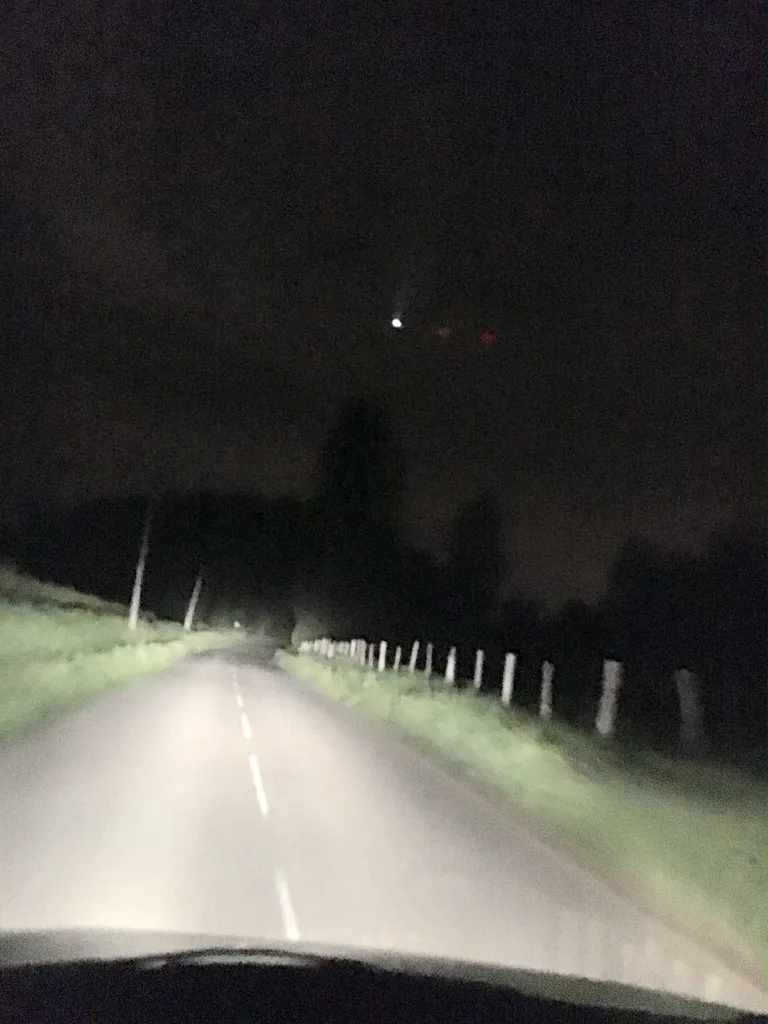
Secondly, I got into the habit of asking people if they had ever seen a UFO, and got far more yeses than I would have expected. It generally didn’t seem like people were lying or crazy. Often they hadn’t made a big deal out of it at all. Perhaps most notably, a friend’s partner shared this photo with me, saying that the light remained still in the sky and made no sound. I don’t think aliens are a particularly likely explanation here, but I will say it is not obvious to me at all what this photo depicts.