On Asking For Help
I’m shamelessly ripping off Inkhaven and doing my own challenge, Egghaven. This is the fourth post.
Six months ago, I asked for help with my mental health, career, and relationships from friends and a large group of strangers. It went better than I expected.
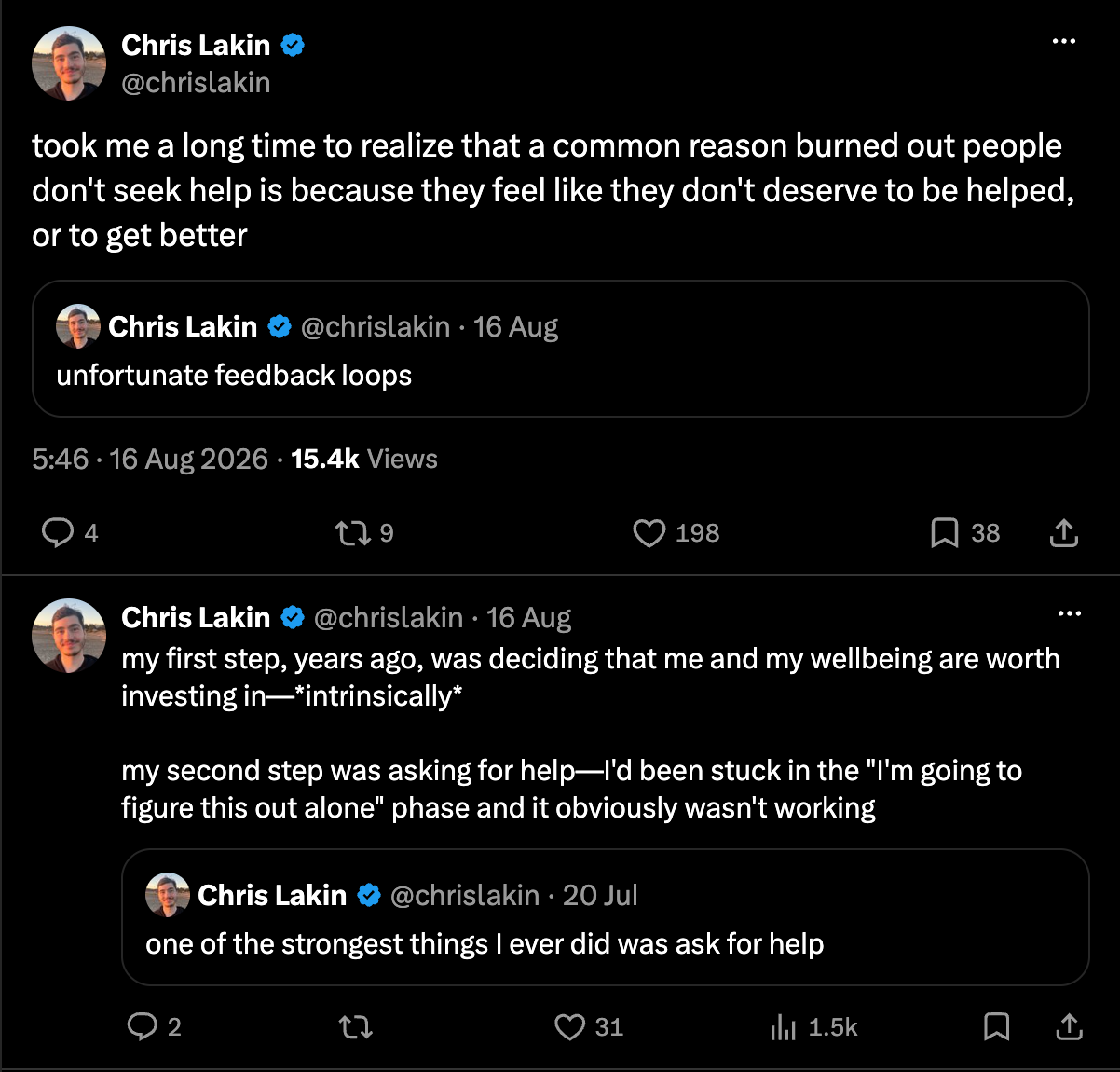
Despite asking for help allegedly being so good, it is not something that comes naturally to me at all. I am one of those, “make yourself as small as possible and never inconvenience anyone in even the slightest possible way so that you can be sure nobody will ever abandon you”-types. In my defence, it’s a good strategy! I have a lot of very close friends. I can’t remember the last time I felt abandoned. Despite this, my situation was clearly not working, and so it was time to try a different strategy, even if it felt scary. And, if I’m being honest, in some sense it wasn’t even that scary – the nice thing about the post was that I wasn’t asking anybody in particular. There was precisely zero pressure placed on any individual to come to my aid. Every single person who saw the post could’ve taken no action based on it and not felt a mite of guilt.
To the credit of the people in both my immediate and extended circles, this is not at all what happened. A bevvy of strangers booked calls and coffees with me. Acquaintances emailed to give their two cents. Friends initiated conversations with me about things that we hadn’t been brave enough to discuss before. I felt more loved than I can remember. It was one of the best experiences of my life.
Now that time has passed since these conversations, I can reflect on which advice bore fruit. These are some of the things that people said to me that stuck with me and seem to have improved my life as a result.
“There is a place for you in EA” - I’d written about some of my reasons for leaving the Effective Altruism community, and this comment was part of the inspiration for my post about returning to the community. Many of the strangers who reached out to me were EAs, and I was reminded that, while the community certainly has problems, it also selects for people who are kind, smart and ambitious. Merely “kind” is perhaps underselling it – they are people who are actively interested in improving their own understanding of morality, in order to be more moral. I think spending time with this type of person pushes me to be a better person. Now I have more clarity on the community’s issues, and I can engage with it in a way that is healthier for me. Effective Altruism has returned to being a significant part of my life, and a part that brings a lot of meaning.
“Consider the spiritual path and attend to your harsh inner critic” - I thought this was very insightful, from an acquaintance I’d only met a couple of times. They picked out that my harsh inner critic underpinned much of my suffering, even though it was only mentioned briefly. While it is not easy to attend to, I do think that spirituality is something worth exploring, given the other things that I’ve tried. I’d previously engaged a little with Buddhism, but I’d not really felt it in my bones. Trying to understand the dharma with my whole body, rather than just my mind, has given me hope that this is a path worth treading.
“Look into neural annealing as a framework for understanding your emotions” - admittedly, I am a little hesitant to include this one. I believe most popular psychological models have some useful truth to them, but are ultimately over-simplified or otherwise lacking. Neural annealing isn’t really a psychological model in the same way as, say, IFS, but they do have some similarities. Still, I have found it a helpful framework to use, if nothing else, because it offers a plausible explanation for why I’m so drawn to ultramarathons. It is a lens I continue to use to think about how to work on my mental health.
“You are likely to exclusively spend time in spaces within which some emotions are perceived as unacceptable. Look for, and spend time in, spaces where any emotion is acceptable. Pursue this even though it will feel uncomfortable at first” - the single best piece of advice I got, by a long way, and from a total stranger. They were exactly right. Every environment I spend any meaningful amount of time in comes with an implicit message that some emotions are not OK – giving me the sense that when I feel those emotions, I am not OK, I do not belong, I am inadequate, etc. At this point, it feels totally normal for me to repress my emotions to this extent and to be highly neurotic. I couldn’t believe how something about my life could be so obviously true, and yet so difficult for me to see. I’ve begun spending more time in more accepting spaces, and it does indeed come with some awkwardness, but it has been tremendously liberating in some ways.
I’m very proud of myself for having asked for help in this way, and still awed by the reception I got. I’ve still got a long way to go when it comes to asking for aid, but it certainly feels easier now than it did in April.